
How Enolgas Valves Are Made

Every first Friday in October, the trades pause to recognize something easy to take for granted: the people and processes behind the products that keep buildings running. National Manufacturing Day falls on October 2 this year — and it’s a fitting moment for Enolgas USA to pull back the curtain on how its valves actually come to life.
It Starts with the Metal

A lot of brass valve manufacturers buy pre-formed components or outsource forging to third parties, then assemble and finish the final product. Enolgas does it differently: forging happens in-house, at its own facility in Italy.
That distinction matters more than it might sound. When forging is handled internally rather than outsourced, a manufacturer controls the process end to end — the metal composition, the forging temperature and pressure, the tolerances, the quality checks — instead of inheriting whatever consistency (or inconsistency) a third-party supplier happens to deliver. It’s the difference between assembling a valve and making one.
Enolgas forges its own brass at its own facility in Brescia, Italy — a region with a long industrial history in precision metalworking. The raw brass arrives on-site as solid rod stock, carefully tagged and tracked by diameter and alloy spec, before it’s forged, machined, and finished into the valve bodies that ship out to installers and distributors across the U.S.

Why In-House Forging Is a Real Advantage
For installers, distributors, and engineers specifying valves for critical applications, in-house forging translates into a few concrete benefits:
Tighter quality control. Every stage of production — from raw brass to finished valve — happens under the same roof, with the same standards, rather than being split across multiple vendors with different quality systems.
Better consistency, batch to batch. When the forging process doesn’t change hands, the product doesn’t either. A valve ordered this year performs the same as one ordered three years ago.
Faster problem-solving. If something needs adjusting — a tolerance, a finish, a material spec — Enolgas doesn’t have to negotiate the change through an outside supplier’s production schedule.
A direct line from craftsmanship to certification. Controlling the forging process end to end makes it easier to maintain the certifications (UL, CSA, lead-free compliance) that installers and engineers depend on.

66 Years of Italian Engineering
Enolgas was founded in 1960, and more than six decades later, the same forge-it-yourself philosophy still drives how products are made. That heritage shows up in the details: the heft of a properly forged brass body, the smoothness of a ball valve’s rotation, the kind of fit and finish that’s hard to fake with a shortcut process.
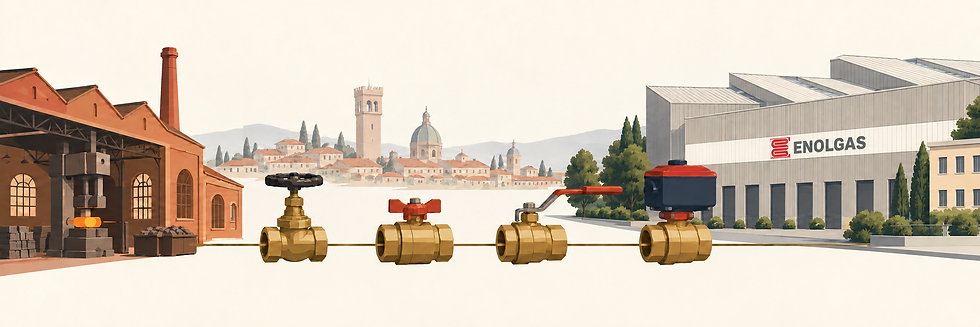
From the Floor in Brescia


What This Means for the Valve in Your Hand
The next time you install an Enolgas gate valve, swing check valve, or hose bibb, it’s worth remembering: that part didn’t just get assembled — it was forged, start to finish, in Brescia, by a team that’s been doing this since 1960. That’s not a marketing line. It’s a manufacturing choice, and it’s one of the reasons Enolgas products hold up the way they do.
Want a closer look at how Enolgas products are made?
Reach out to the team at sales@enolgasusa.com.


Comments