
Why Balancing Valves Matter in Heating and Cooling Systems
Updated: Aug 27

In hydronic heating and cooling systems, water flow plays a major role in comfort, performance, and energy efficiency. When each branch of a system receives the correct flow rate, every terminal unit — whether it is a radiator, fan coil, heat exchanger, or cooling unit — can operate as designed.
When flow is not properly balanced, some areas may receive too much water while others
receive too little. This can lead to uneven temperatures, inefficient energy use, and a system that works harder than it needs to. That is where balancing valves come in.
Balancing valves help regulate flow throughout a system so each branch receives the proper amount of water. For HVAC contractors, engineers, and facility teams, they are an important part of building reliable and efficient heating and cooling systems.
What Happens When a System Is Not Balanced?

In a typical heating or cooling circuit, different branches often have different pressure losses. Some zones are closer to the pump, while others are farther away. Some runs may be shorter and more direct, while others may include more fittings, coils, or restrictions.
Water naturally follows the path of least resistance. Without proper balancing, this can cause some branches to receive more flow than required, while other branches are under-supplied.
The result can include:
• Uneven room temperatures
• Reduced comfort
• Poor system control
• Energy waste
• Increased strain on pumps and equipment
• Difficulty maintaining design performance
In heating and cooling systems, this imbalance can quickly affect both comfort and operating costs.
Manual Balancing vs. Automatic Flow Control
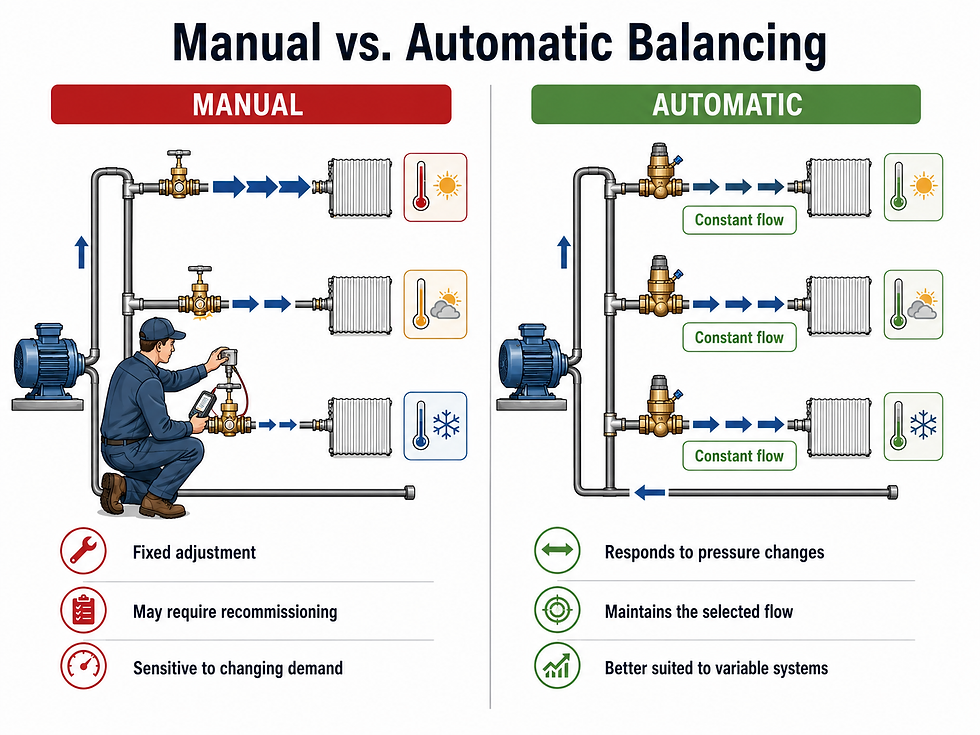
Traditional balancing is often done with manually adjusted valves. During commissioning, each valve is set to reach the desired design flow rate. This can work well when the system remains under the same operating conditions. The challenge is that most systems are not static.
As zones open and close, as thermostats call for heating or cooling, and as users change demand throughout the building, pressure conditions inside the system also change. In a manually balanced system, those changes can affect the flow going to the remaining branches.
This may cause some areas to become over-supplied while others lose performance.
Automatic balancing valves are designed to help solve this issue. Instead of relying only on a fixed manual setting, they help maintain a constant flow rate as differential pressure changes within the system.
How an Automatic Flow Rate Setter Works

An automatic flow rate setter is designed to maintain a stable flow rate even when the pressure upstream and downstream of the valve changes.
Inside the valve, a regulating cartridge responds to changes in differential pressure. As pressure varies, the cartridge adjusts the internal passage to help keep the flow close to the nominal set value. This allows the system to maintain more consistent flow through each branch, even when other parts of the system are opening, closing, or changing demand.
In practical terms, this helps each branch receive the flow rate defined during the design phase, supporting more stable comfort and better energy distribution.
The Importance of the Operating Range

Automatic balancing valves are designed to work within a specific differential pressure range. For Enolgas USA’s future incoming automatic flow rate setter, the working differential pressure range is 15–200 kPa, or 0.15–2 bar. Within this range, the internal cartridge helps regulate the flow to the nominal value.
There are three general operating scenarios:
Below the working range:
The differential pressure is not high enough to fully activate the cartridge. In this zone, flow
remains more dependent on the available pressure.
Within the working range:
This is the ideal operating zone. The cartridge regulates the flow and helps keep it constant as differential pressure varies.
Above the working range:
The cartridge reaches the end of its stroke. At this point, the system is outside the recommended range, and maintaining nominal flow is no longer guaranteed.
For proper performance, it is important to verify that the system’s differential pressure stays
within the specified operating range.
Why Balancing Is Different for Heating and Cooling
Heating and cooling circuits often require different flow rates.
Cooling systems usually operate with a lower temperature difference, or ΔT. Because of this,
they often need a higher flow rate to move the required amount of energy.
Heating systems may operate with a higher ΔT, which means a lower flow rate can often be
sufficient.
This is why selecting the correct calibrated flow rate matters. In dual heating and cooling
systems, the heating and cooling branches may require differently calibrated balancing valves to match the needs of each circuit.
Balancing is not just about installing a valve. It is about choosing the right valve and the right flow rate for the application.
Key Applications for Balancing Valves
Balancing valves and automatic flow rate setters are especially useful in systems where different branches have different pressure drops or changing demand conditions.
Common applications include:
• Hydronic heating systems
• Chilled water systems
• Fan coil units
• Radiator circuits
• Multi-zone HVAC systems
• Commercial buildings
• Mechanical rooms
• Heating and cooling distribution circuits
In these applications, stable flow can help support consistent comfort, improved control, and more efficient system operation.
Enolgas USA Automatic Flow Rate Setter: Coming Soon

Enolgas USA will soon be adding automatic flow rate setter options to its product offering.
These incoming balancing valves are designed for heating and cooling systems where constant flow regulation is needed.
The valve automatically helps maintain a set flow rate as differential pressure changes in the
system. This helps reduce the imbalances that can occur in multi-branch circuits and supports better energy distribution across connected users.
Key features include:
• Automatic constant flow regulation
• Designed for heating and cooling applications
• Helps maintain stable flow as pressure conditions change
• Supports better comfort and system efficiency
• Replaceable regulating cartridge
• Compatible with antifreeze fluids with glycol up to 50%
• Fluid temperature range from -20 °C to 100 °C
• PN 10 pressure rating
• Available fixed nominal flow rates from 0.343 to 4.49 gpm
This type of solution can be especially helpful in systems with radiators, fan coils, or branches with different pressure losses, where automatic regulation can help each user receive the intended flow.
Maintenance and Replaceable Cartridges
Another useful feature of this incoming product is the replaceable cartridge design.
The internal cartridge can be removed for cleaning, maintenance, or replacement. This allows the valve to be serviced if needed and also gives flexibility if the system design changes over time.
When replacing the cartridge with one of a different capacity, the valve labeling should also be updated so the installed flow rate remains easy to identify during future service or inspections.
Better Flow Means Better System Performance
Balancing valves may be small components, but they can have a major impact on system
performance.
A properly balanced system helps deliver the right flow to the right place at the right time. For contractors, engineers, and facility teams, that means more predictable operation and better longterm performance.
Automatic balancing solutions can help support:
• More consistent comfort
• Better system control
• Reduced energy waste
• More stable flow across multiple branches
• Easier system operation
• Improved performance in heating and cooling circuits
As HVAC and hydronic systems continue to prioritize efficiency, control, and reliability,
automatic balancing valves are becoming an important part of modern mechanical system
design.
Enolgas USA: Supporting Smarter Hydronic Systems
At Enolgas USA, we continue to expand our product offering to support heating, cooling,
plumbing, gas, industrial, and automation applications. Our upcoming balancing valve solutions are designed to help professionals build more efficient, reliable, and better-performing systems.
From product design and manufacturing to distribution and technical support, Enolgas USA
provides the products and knowledge needed to support today’s mechanical systems — all under one umbrella.
Contact Enolgas USA to learn more about upcoming balancing valve availability, technical specifications, and product support.


Comments